
Follow us on:
Child Social Emotional Development: Quick Parent Checklist

The Heart of Social Emotional Growth: A Comprehensive Guide
Child social emotional development is often called the “hidden foundation”. While we celebrate physical milestones like a first step or a lost tooth, the internal milestones, learning to wait, showing empathy to a friend, or recovering from a disappointment, are what truly shape a human being’s character.
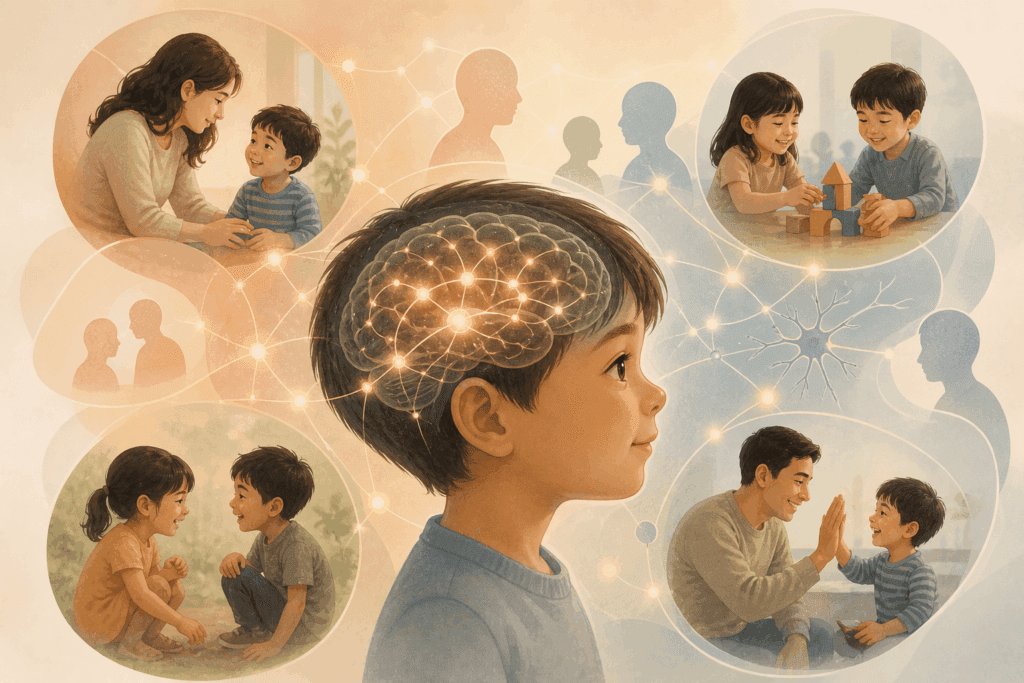
This journey begins at birth. Every time you comfort a crying infant, you are not just stopping a noise; you are building the neural pathways for trust and security. This guide explores how to nurture these skills through every stage of early childhood.

The Five Pillars of the Inner World
Social-emotional learning is generally divided into five key areas. Understanding these helps parents see the “why” behind their child’s behavior.
1. Self-Awareness: The Internal Mirror
Self-awareness is the ability to recognize one’s own emotions and thoughts. For a very young child, this is a physical experience. They might feel a “tightness” in their chest but do not know it is anxiety.
- The Parent’s Role: Be the narrator. When you see your child jumping for joy, say, “You look so excited! Your whole body is wiggling with happiness.” This helps them link the physical feeling to the word.
2. Self-Management: The Steering Wheel
Once a child knows what they feel, they must learn how to handle it. This involves impulse control, the ability to stop oneself from hitting or grabbing, and emotional regulation.
- The Parent’s Role: Model the “Pause.” When you are frustrated (perhaps you dropped a glass or are stuck in traffic), talk through your process out loud. “I am feeling very frustrated right now. I am going to take a deep breath before I clean this up.”
3. Social Awareness: The Window to Others
This is the birth of empathy. It is the realization that other people have feelings, and those feelings might be different from the child’s own.
- The Parent’s Role: Use “perspective-taking” questions. While reading a book, ask, “How do you think the bear felt when his friend forgot his birthday?”
4. Relationship Skills: The Social Toolbelt
These are the mechanical skills of life: sharing, listening, cooperating, and resolving conflict. These skills are rarely “natural”, they must be practiced thousands of times.
- The Parent’s Role: Create “low-stakes” practice. Use puppets or stuffed animals to act out a social problem, like two friends who both want to sit in the same chair, and ask the child to help them solve it.
5. Responsible Choices: The Compass
This is the ability to make constructive choices about personal behavior. Even a toddler can start this by understanding that if they throw a toy, the toy has to go away for a while.
- The Parent’s Role: Focus on natural consequences. Instead of a random punishment, use a consequence that makes sense. “If we don’t put our shoes on, we won’t have time to stop at the park on the way to the store.”
The Developmental Journey
A child’s brain changes rapidly in the first several years. Knowing what is “normal” helps parents stay patient.
The First Year: The Year of Trust
In the first several months, the main social goal for an infant is to build a secure attachment. During this time, the baby learns that when they have a need, a caregiver will respond and meet it. This consistent care creates a “secure base,” which helps the child feel safe and supported as they grow and begin to explore the world. You can often see this development through key behaviors such as tracking faces, smiling socially, and “babbling” back and forth with a caregiver as a form of early communication.
The Second and Third Years: The Year of Independence
This stage is often challenging for parents because the child is starting to discover their own “will.” They want to do things independently, but they often lack the physical or emotional skills to succeed, which leads to frustration. Common behaviors include saying “no,” showing strong preferences, and experiencing separation anxiety, all of which are signs of healthy growth.
The Fourth and Fifth Years: The Year of Connection
By this age, children begin to shift from playing alongside others to actively playing with them. They start to understand simple rules and can begin to negotiate during interactions. This development is shown through imaginative play, attempts at sharing (often with reminders), and a growing desire to please the adults in their lives.
The Power of Play in Social Development
Play is not “just fun”,it is the serious work of childhood. It is the laboratory where children test social theories.
- Solitary Play: Helps a child learn to be comfortable in their own company and focus on a task.
- Parallel Play: When two toddlers play with blocks near each other but don’t interact. This is a vital step in feeling comfortable around peers.
- Cooperative Play: When children work together to build a “fort” or act out a story. This requires advanced communication and compromise.
Strategy for Parents: Follow the “One-Inch Rule.” During play, stay just one inch behind your child’s lead. If they want the toy car to go to the grocery store, don’t tell them cars go to the garage. Let them lead the story. This builds their confidence as a social partner.
Emotional Regulation and the “Calm Captain”
A child’s nervous system is like a small boat in a big ocean. When a storm (a tantrum) hits, they need their parents to be the “Calm Captain” of the ship.
Co-Regulation
Before a child can learn to calm themselves, they first need to be “co-regulated” by an adult, meaning your calm presence helps their body settle. This can be done by lowering your voice, getting down to their eye level, and offering a hug or gentle, firm touch if they find it comforting. By breathing slowly and deeply, you also guide their body to match your rhythm, helping them feel safe and regulated.
The “Calm-Down Kit”
As children approach age four or five, they begin to use simple tools to help manage their emotions. For example, you can prepare a small “calm-down” basket that includes items like a glitter jar to watch, a soft stuffed animal for comfort, a book about feelings, and a stress ball to squeeze when they feel overwhelmed.
Mastering Conflict: The Peace Table
Conflict is an unavoidable part of social life. Rather than trying to stop every argument, we should view them as “teaching moments.”
The Four-Step Conflict Resolution:
- Stop and Breathe: No one can solve a problem while they are screaming. Wait until the “emotional fever” has broken.
- The “I” Statement: Encourage each child to say, “I felt [feeling] when you [action].” This prevents the “Blame Game.”
- The Brainstorm: Ask the children, “What are three ways we could fix this?” Let them come up with ideas, even if they are silly.
- The Handshake: Once a solution is picked (like using a timer for the toy), have them acknowledge the agreement.
The Science of the “Social Brain”
The brain grows more in the first few years than at any other time. Social-emotional skills are tied directly to the development of the prefrontal cortex, the part of the brain that handles logic and “big picture” thinking.
However, when a child is upset, the “emotional center” (the amygdala) takes over. In these moments, the child literally cannot hear logic. This is why “talking it out” only works after the child has calmed down. Using respectful parenting scripts during these moments helps bridge the gap between the emotional brain and the logical brain.
When to Seek Extra Guidance
Every child has a unique “temperament.” Some are naturally more social, while others are more observant and quiet. However, if you notice the following patterns, it may be helpful to consult a professional:
- The child consistently avoids eye contact or does not respond to their name.
- The child shows no interest in playing with or near other children.
- Tantrums are becoming more frequent or violent as the child gets older, rather than decreasing.
- The child seems unable to be comforted by a primary caregiver.
Pediatricians and early childhood specialists can provide evaluations that offer peace of mind or a clear path for support.
The Parent’s “Internal Script”
Social-emotional development is a two-way street. Your child learns how to handle stress by watching you. This is why self-care is not a luxury; it is a parenting tool.
- The Power of the “Reset”: If you have a bad morning where everyone is yelling, call for a “Reset.” Say, “Whew, this morning has been hard for all of us. Let’s all take a big breath and start over.”
- The Humble Apology: When you make a mistake, apologize to your child. “I’m sorry I used a loud voice. I was feeling frustrated, but that wasn’t the right way to show it.” This teaches them that mistakes aren’t the end of the world, they are opportunities to repair a relationship.
A Simple Monthly Reflection Checklist
Instead of worrying every day, it can help to pause once a month and look at the bigger picture of your child’s development and your own well-being. You might reflect on whether your child feels safe coming to you when they are sad or scared, whether they are beginning to use words (even just a few) to express their needs, and whether you’ve noticed small moments of “accidental kindness,” like offering a toy to a sibling. At the same time, it is just as important to ask yourself if you are taking enough breaks to stay calm and present when your child is having a hard time.
Conclusion: The Long-Term Vision
The goal of supporting social-emotional development is not to raise a “perfectly behaved” child, but to help shape an adult who can navigate the complexities of life, and if you ever need guidance along the way, you can reach out for support here. By prioritizing empathy over obedience and connection over control, you give your child the foundation to understand themselves and others, building the ability to form healthy and meaningful relationships.
This journey requires patience and consistent effort, but the result is a resilient and confident child who is ready to face the world. Keep your heart open, stay steady in your care, and remember that every small interaction plays a role in building your child’s future, and you can continue learning and finding support anytime through the app on the App Store or Google Play.
FAQs (Frequently Asked Questions)
What is social emotional development and why is it important in early childhood?
Social emotional development refers to the growth of skills like self-awareness, emotional management, relationship building, and responsible decision-making. It is crucial in early childhood as it supports healthy brain development, school success, mental health, and physical well-being.
What are the key competencies involved in social emotional development for young children?
The key competencies include self-awareness, self-management, social awareness, relationship skills, and responsible decision-making. These develop progressively from birth through early childhood and form the foundation for healthy social interactions and emotional regulation.
How can parents recognize typical social emotional milestones in infants and toddlers?
Parents can observe milestones such as making eye contact, smiling, cooing, responding to voices, and showing affection. Engaging in loving interactions like talking and reading together also supports these developmental signs.
What strategies can parents use to support their child’s social emotional growth at home?
Parents should provide consistent and responsive care by building steady caregiver relationships that foster trust and emotional safety. Encouraging positive social skills through play, like sharing, turn-taking, and expressing feelings, and helping children identify and manage emotions through naming feelings and calming techniques are effective strategies.
When should parents consider seeking professional help for their child’s social emotional development?
If parents notice signs of developmental delays or persistent extreme behaviors that impact daily functioning, it is important to seek early intervention through professional assessment to address potential concerns promptly.
How does supporting social emotional development benefit children long-term?
Supporting social emotional development helps build children’s confidence and strengthens their relationships. This foundation promotes success in school, fosters mental and physical health, and encourages responsible decision-making throughout life.